
Pre-final
entertainment: the Drum Band, and Matt Windle reads his poem,
"Badminton"
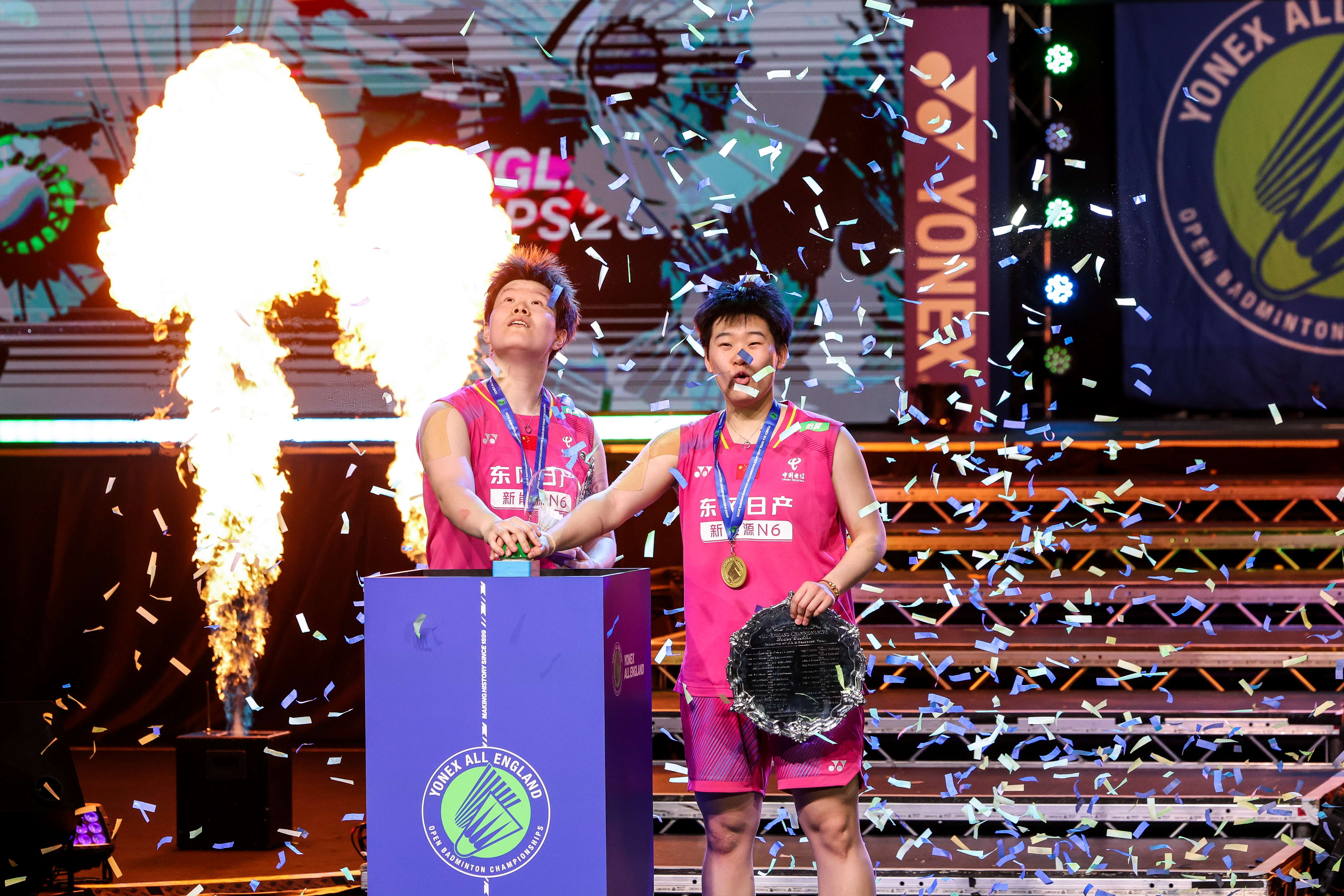
XD Zhang Nan & Zhao Yunlei (Chn) bt [2] Nova Widianto
& Liliyana Natsir (Ina)
21-18 23-25 21-18
(90m)
New stars are born
Zhang Nan
and Zhao Yunlei, a brand new partnership which does not even
appear in the world's top 100 , sensationally joined the very
few unseeded players to have won the All-England Open, and had
to qualify to do it.
In
only their third Super Series tournament together Zhang and Zhao
completed their destruction of a stellar field by beating Nova
Widianto and Lilyana Natsir, the second-seeded former world
champions from Indonesia, 21-18, 23-25, 21-18.
It followed the Chinese pair's conquest of their top-seeded
compatriots Zheng Bo and Ma Lin in the second round, and
announced them as a major threat for the forseeable future.
"The second round match was the toughest," said Zhang. "Then
after that it has been easier – and of course there has been no
pressure of expectations."
That comment though did little justice to a marvellous 89-minute
match in which the advantage fluctuated first one way and then
the other, the rallies switching between defence and attack,
slow and fast, with fascinating complexity.
The Chinese fought back from 12-17 and 14-18 in the first game,
and from 5-11 in the second game, and advanced to match points
at 20-19 and 21-20. Nova Widianto brilliantly saved both, one
with a great switch of direction across court, one with some
potent smashing.
Generally though both pairs found
it hard to ram attacks through in slow conditions, which made
for some ingenious tactical variations and subtle changes of
pace which the crowd loved.
The variety was made all the more intricate by the fact that the
two women were so strong that there were occasions when both
partnerships were able to play more like a conventional doubles
pair, fluidly changing, and with the woman somtimes trying
smashes from the back instead of the man.
For
a while it seemed that the saved match points had generated
enough momentum for the Indonesians to go on to win the match.
They advanced steadily to 9-3, 11-6 and 12-8 in the final game,
before the Chinese fought back again.
As the match moved past the hour mark, they were slightly the
more energetic pair, and some lively attacks from Zhang and some
sturdy defence and sharp interceptions by Zhao got them back to
parity at 14-14.
That was the a crucial twist. The Indonesians hung on bravely,
but the two most vital moments came at 19-18 when a slightly
tiring Natsir, under pressure, blocked one forecourt shuttle
just wide, and lifted another long.
The Chinese celebrated with exuberant hugs – China had kept on
course for a possible three All-England titles and a new world
class partnership had been born.
Tine regains the
title at her second home Richard Eaton
Tine
Rasmussen produced one of the most remarkable against-the-odds
triumphs when she regained the All-England women's singles title
after months of injury problems and without any notable
successes since winning October.
The unseeded Dane beat the top-seeded titleholder from China,
Wang Yihan, 21-14, 18-21, 21-19, in the process overcoming an
opponent who is much stronger and more confident than when she
lost to her in last year's final.
Then Wang was unseeded and little known. Now she came with Super
Series titles in Hong Kong, Japan, and Switzerland behind, and
an attack which had made her one of the most feared player on
the Super Series circuit.
But despite two great fight-backs, from losing the first game,
and from 14-17 down in the second to 17-17, Wang could not get
past an opponent who gets fire in her eyes and adrenaline in her
guts, and a feeling that she is at a second home when she plays
at the All-England.
“I
went on court without feeling nervous at all, said Rasmussen.
“It was all very clear to me what I had to do and I was just
feeling good and enjoying being there.”
She came out like a train, switching the shuttle from side to
side with flat lifts, getting her big smash in whenever there
was half a chance and playing the rallies at a greater speed
than she before.
Against Lu Lan, the world champion in the semi-finals, she had
saved three match points by steadying her game up. Now she went
full out on to the attack and for a while blew the favourite
aside.
She was a couple of points ahead at once, 11-7 up at the
interval, and 19-11 ahead before Wang began to restore some
order to her game, which had been hustled and harried, and then
bombarded by big blows, until it was a ragged spectre of its
usual self.
To her great credit though Wang got herself back into the match
well. The change of ends made it harder for Rasmussen to take
charge, and the physical effort of her early ambush may have
taken a small amount of wind from her lungs as well.
Wang continued high serving most of the time, prepared to risk
one heavy blow on the return to be able to
block or counter-attack from a good position. Rasmussen
continued mostly low serving, but Wang was making more progress
in those rallies too.
Now she was making advances – not as rapidly as Rasmussen had,
but steadily and ominously from 11-8 at the interval to 14-9
with a block lift winner, and to 20-13 with a persistent attack
finished by a lunging net kill.
But on the brink of levelling Wang faltered. Rasmussen sensed
the change of mood, cranked up her attack again, and took five
points in a row with tight net shots and cross court switches.
By
the time Wang stopped the slide with a smash-tumbler-kill
combination, Rasmussen had gained an insight that her opponent
might be more fallible than she had been before.
This may have helped her when she was trailing 3-6 and 5-7 in
the final game, and when her first storm of attacking seemed far
behind her. For suddenly Rasmussen resurrected her aggression
and took six stunning points in a row.
Three of them came from mistakes by Wang, and three from
pressure applied by Rasmussen, one a net shot and kill
combination which got her to the interval at 11-7.
Then came a Wang fightback to 12-12 and 14-14, followed by
another Rasmussen surge to 17-14 as the two women fought to keep
control of their emotions and tiring bodies as the climax to the
contest approached.
Wang got back again to 17-17, and Rasmussen suddenly looked very
tired, but at that moment Wang served out and the Dane noticed
that the Chinese player might be a little nervous and roused
herself for one last effort.
She also, she said, had flashbacks to the 2008 final, when she
had beaten Lu Lan in the final, and tried to keep the image of
that in mind.
A
flick-lift to the backhand, perfectly in the corner got her to
19-18, another lift was deep enough to make Wang produce a
clearing errors, and two more lifts created just enough of an
opening for Rasmussen to bang one more of those big smashes to
the floor amidst a ferment of noise.
The racket went flying again just
as it had against Lu Lan, and this time Rasmussen was in tears
as she embraced coach Kenneth Jonassen. “This is unbelievable,”
she said. “It feels totally wonderful.”
“I made more mistakes today,” said Wang. “And when I had the
opportunities I couldn't hold on.” She sounded almost as
surprised as some of her listeners. But it had been a final to
remember.
MS [1] Lee
Chong Wai (Mas) bt Kenichi Tago (Jpn)
21-19, 21-19 (47m)
Lee wins the all-England at last Richard Eaton
Lee
Chong Wei, the man who has dominated the Super Series circuit
without winning the major titles, went some way to improving his
big occasion record by capturing the All-England Open.
The top-seeded Malaysian did that with a 21-19, 21-19 win over
Kenichi Tago, the first Japanese male finalist for nearly half a
century in which Lee's experience just got him through in the
tight finishes in both games.
Lee also became the first man to win three Super Series titles
in a row, having captured the titles in Seoul and Kuala Lumpur
in January.
Just before giving his press conference Lee received a phone
call of congratulations form the Malaysian prime minister, Datuk
Seri Najib Abdul Razak, and came into the room buzzing with the
thrill.
"It was a big relief to win and a big dream especially as its
the 100th anniversary of the All-England," said Lee. "It's going
to help me in a big way. I didn't think I played my very best
but I did enough."
But
the his 20-year-old unseeded opponent, who had already accounted
for three seeded opponents, once again impressed with his speed
and attacking verve, and was not far from causing another upset.
Lee's capture of the title in the 100th tournament of the
world's oldest badminton event, even though he looked a worthy
favourite, may not convince everyone that he is now the best
player in the world
That is because Lin Dan of China won both the Olympic and World
titles, skipped the first two Super Series of the year and
mysteriously lost to his compatriot Bao Chunlai here.
But Lee did suggest that he is adding a better big match
temperament to his blistering speed, great defence, and cleverly
timed counter-attacks, and may be improve enough to challenge
Lin Dan's ambition to retire as Olympic champion at London 2012.
Lee also recovered from an uncertain start, going 0-4, 5-10 and
11-15 down to an opponent who had nothing to lose and came out
attacking whenever he could.
The
Malaysian made a well-timed push with six points to reach 17-15,
and when Tago got back to 19-20 Lee had a slice of good fortune
when his attempted kill took a net cord which left his opponent
for dead.
Lee played more relaxedly
after that, getting to 6-1 quickly. Even when Tago caught him at
11-11 and kept in touch up till 17-18, Lee was playing more
aggressively himself now.
This time at 20-19 he won the crucial point more worthily,
choosing an accurate push down the middle, awkwardly close to
Tago's body, to make the championship-grabbing winner.
Lee celebrated by burying his forehead on the court, by hurrying
to thank his coach Misbun Sidek, and by raising both fists to
the crowd. It may prove a turning point in his career.
WD [1] Du
Jing & Yu Yang (Chn) bt [3] Cheng Shu & Zhao Yunlei (Chn)
20-22, 21-16, 21-13 (69m)
Du and Yu do it for China Richard Eaton
Li
Yongbo, China's famous head coach, was not too disappointed even
though his squad had won all five titles last year and now had
to be content with two.
The second of these saw Du Jing and Yu Yang, the top-seeded
Olympic champions, come from a game and 12-15 down to beat their
compatriots Zhao Yunlei and Cheng Shu 20-22, 21-16 21-13.
It was a long drawn-out effort, and one which saw Yu receive
treatment on her shoulder, with both players requiring treatment
on shoulders afterwards. That was partly the result, they
claimed of slow shuttles.
Their
success prevented Zhao from becoming the only player in the
tournament to win two titles - instead she had to be satisfied
with an outstanding effort in winning the mixed doubles with
Zhang Nan.
The other Chinese finalist was Wang Yihan, who only narrowly
lost the women's singles final, a match about which Li did admit
a degree of disappointment.
“She should have got it,” he reckoned. “It was a shame. Also
most of the Chinese players ended up in the same half of the
draw.” (There were four in the top half and two in the bottom).
Of China's unexpected failure to win the men's singles, Li said:
“Lin is always the one to win it. Chen has won it once, so it
was a good chance for Bao (Chunlai) to try. We didn't expect
Chen to lose to Tago. But the Japanese player is good.”
Zhang
Nan's performance in the mixed doubles had been better than
expected, Li said, and concluded his comments on the loss of the
two singles titles by saying: “Every match has a winner and a
loser - so it's normal.”
The women's doubles final was a match which suggested that
standards are rising. Most of the rallies saw one pair or the
other trying to press home an attack, unlike some matches in
this discipline which can become attritional.
And, in a see-saw encounter, the outcome was always in doubt.
The third-seeded Zhao and Cheng moved into leads of 11-6, 14-8
and 19-6, but Du and Yu caught them at 20-20 and looked likely
to take the game until Zhao made a couple of good thrusts to
sneak it.
When they reached 15-12 Zhao and Cheng looked odds on to become
champions, but suddenly Du and Yu ignored their aching shoulders
and let rip with a battery of fast jabs and smashes, taking nine
of the next ten points to level at a game-all.
It
turned the match. Du and Yu took the lead immediately in the
third and were never headed, accelerating from 11-11 with eight
of the next nine points with a display of consistent aggression.
“We had tried five times and only been runners-up before and
never been champions,” said Yu. “We both wanted it badly.”
“It was a shame to lose the first game,” said Du. “But we still
believed we could do it, even though both of us were hurting in
the shoulder.”
Danish doubles delight as four
match points are saved Richard Eaton
Denmark, a nation with only five million people, amazingly won
two All-England titles and thus matched the achievement of
China, the country whose 1.3 billion makes it fully 160 times
more populous.
That became certain from the moment Tine Rasmussen won back the
women's singles, for the Danes provided both men's doubles
finalists, making it the first all-European final in this event
since 1983.
It
became one of the longest too. Lars Paaske and Jonas Rasmussen
needed an hour and a half before they got the better of Mathias
Boe and Carsten Mogensen by 21-23, 21-19, 26-24, saving four
match points in a frenetic finish.
“It is an indescribable feeling to win this tournament. It's a
great feeling to stand with the gold medal, especially as it was
such a fantastic match,” said Paaske.
“Denmark would win no matter what happened in this final, but I
am glad that it was such a great match.”
It was possibly the All-England's latest finish as well, for it
was almost 8.30pm by the time Paaske flashed a backhand jab
across court and ended the challenge of their more highly rated
opponents.
Boe and Mogensen had been seeded fourth and Paaske and Rasmussen
not at all after Paaske's injury problems had caused them to
slip out of the world's top eight.
They did though win the world title seven years ago, and perhaps
it was the experience of succeeding on a very big occasion which
got them through in the fraught final stages when it seemed that
Boe and Mogensen had the edge.
They
were the younger pair and were moving the better, but they were
also subject to greater fluctuations in standard.
In the second game they led 19-18 but couldn't force their way
through. Then in the third game they allowed Paaske, who was
often excellent at the net, and Rasmussen to get away from them.
Not till they were 12-17 down did Boe and Mogensen begin to get
some momentum again, though they were tactically restricted by
the flat and staccato patterns which Paaske and Rasmussen
imposed.
At 21-20, 22-21, 23-22, and 24-23, it seemed that Boe and
Mogensen were going to make one quick thrust that would finish
it, but each time Paaske and Mogensen did just about everything
right, played tight and accurate pushes and jabs, and never got
pulled out of position.
When they closed it out, slightly against the odds, and at the
second attempt, Paaske fell to the ground like a log, and
Rasmussen came over to share the experience with him, only to
find his partner oblivious. So Rasmussen made the best of the
situation by rolling over himself.
It added a little more unpredictability to a tournament in which
three of the five champions had been unseeded. That may be,
though it is difficult immediately to tell, a record.